


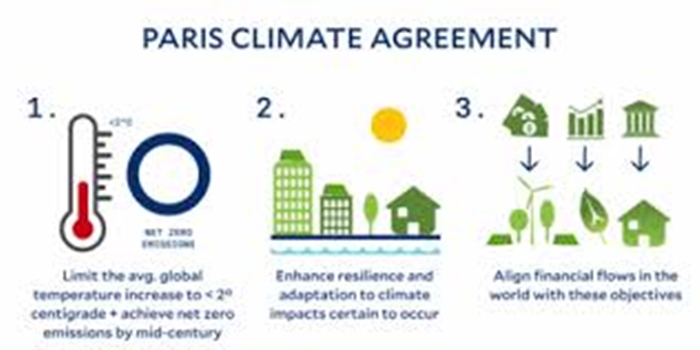
This essay explores how climate diplomacy has evolved after Paris, examining new agreements, political tensions, financial debates, and emerging geopolitical realities.
The Core Architecture of the Paris Agreement
The Paris Agreement introduced a flexible, bottom-up framework based on:
Nationally Determined Contributions (NDCs)
A five-year review cycle (the “ratchet mechanism”)
Transparency and reporting requirements
Climate finance commitments
A long-term net-zero goal
Unlike previous treaties such as the Kyoto Protocol, Paris did not impose binding emissions targets on individual countries. Instead, it required countries to set their own targets and progressively increase ambition over time.
This shift reflected political realities: rigid top-down targets had proven difficult to sustain.
The Politics of Implementation
- National Sovereignty vs Global Responsibility
After Paris, climate diplomacy entered an implementation phase. Countries began translating pledges into domestic policy. However, tensions quickly emerged:
Developing nations emphasized climate justice and historical responsibility.
Developed nations focused on accelerating emissions reductions.
Fossil fuel-dependent economies resisted rapid transitions.
Climate politics increasingly became a negotiation between environmental urgency and economic stability.
Major Developments in Climate Diplomacy After Paris
- Net-Zero Commitments
One of the most significant political shifts after Paris has been the widespread adoption of “net-zero” targets. Major emitters, including the United States, European Union, and China, announced long-term carbon neutrality goals.
These pledges transformed climate ambition into a central element of national strategy. However, critics argue that long-term targets must be matched with short-term action.
- Climate Finance Debates
Climate finance remains one of the most politically sensitive issues in global negotiations.
Developed countries pledged to mobilize $100 billion annually to support developing nations. Disagreements persist over:
Funding levels
Distribution mechanisms
Loans vs grants
Accountability
At recent UN climate conferences (COP summits), negotiations have increasingly centered on “loss and damage” funding for countries already suffering climate impacts.
Climate Finance and North–South Tensions
One of the most contentious issues after Paris has been climate finance.
Developed countries pledged to mobilize $100 billion annually to support developing nations in mitigation and adaptation. However:
Delivery has often fallen short.
Disputes persist over loans vs. grants.
Vulnerable states demand compensation for irreversible climate damages.
The Rise of Net-Zero Politics
After Paris, many countries announced net-zero emissions targets:
Mid-century neutrality pledges
Long-term decarbonization strategies
National carbon pricing systems
However, critics argue that some net-zero commitments lack credible short-term action. This has led to greater scrutiny from civil society, scientists, and climate activists.
Private Sector and Non-State Actors
Post-Paris climate governance expanded beyond national governments:
Corporations committing to science-based targets
Financial institutions aligning portfolios with net-zero pathways
Cities and regions forming climate alliances
Private actors increasingly shape climate outcomes through investment decisions, ESG standards, and technological innovation.
Climate Justice and Adaptation
Beyond mitigation, adaptation and resilience have gained prominence. Many developing countries prioritize:
Infrastructure resilience
Food security
Water management
Disaster risk reduction
Climate justice arguments emphasize that those least responsible for emissions often suffer the worst consequences.
The Rise of Climate Litigation
Climate politics has moved beyond diplomatic halls into courtrooms. Governments and corporations face lawsuits over emissions and climate responsibility.
Judicial systems in multiple countries are now shaping climate accountability, creating a new layer of political pressure.
Trade and Climate Linkages
Climate policy is increasingly tied to global trade.
For example, the EU introduced mechanisms designed to prevent “carbon leakage” by imposing climate-related standards on imports. Such policies blur the line between environmental protection and economic competition.
This shift reflects how climate politics now intersects with industrial policy and global competitiveness.
Challenges in the post-Paris Era
Despite progress, significant challenges remain:
- Ambition Gap
Current NDCs still fall short of limiting warming to 1.5°C.
- Implementation Gap
Even pledged targets are not always met.
- Fossil Fuel Dependence
Many economies remain heavily reliant on coal, oil, and gas.
- Political Backlash
Climate policies sometimes face domestic resistance due to concerns over energy prices and employment.
- Global Crises
Pandemics, wars, and economic instability can divert attention and resources away from climate action.
- Adaptation and Resilience: A Growing Focus
While early climate diplomacy emphasized emissions reduction (mitigation), post-Paris negotiations increasingly prioritize adaptation:
Infrastructure resilience
Disaster preparedness
Water management
Agricultural transformation
As climate impacts intensify, adaptation funding has become politically urgent.
The Future of International Climate Agreements
The Paris Agreement established a flexible framework designed to evolve. Its long-term effectiveness depends on:
Strengthened five-year review cycles
Transparent reporting mechanisms
Scaled-up finance
Technological innovation
Political will
Future negotiations may focus more explicitly on:
Phasing down fossil fuels
Scaling renewable deployment
Enhancing climate justice frameworks
Integrating biodiversity and climate policy.
Conclusion
Climate politics after the Paris Agreement has become more interconnected, more ambitious, and more contested. What began as a diplomatic breakthrough has evolved into a complex global transformation process affecting energy systems, trade, finance, development, and geopolitics.