


Introduction
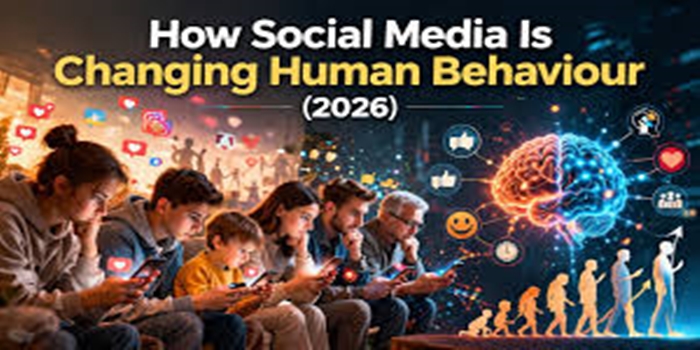
Social media has evolved from a simple communication tool into a powerful force that is actively reshaping human behavior. Platforms like TikTok, Instagram, and Facebook are not just influencing what people see, they are influencing how people think, react, and interact with one another. Today, habits such as constant scrolling, seeking validation through likes and comments, and reacting instantly to information have become part of everyday life. The way people form opinions, express emotions, and even measure self-worth is increasingly tied to digital interactions. What once happened face-to-face is now often filtered through screens and algorithms.
The Digital Mirror: Identity and Self-Perception
Social media has fundamentally altered how people construct their identities. Instead of identity being formed privately or within close social circles, it is now performed publicly.
Platforms encourage users to curate idealized versions of their lives—highlight reels rather than full realities. Over time, this creates a feedback loop:
People post content to gain validation
Validation (likes, comments) reinforces certain behaviors
Those behaviors become part of their identity
Research shows that this dynamic can significantly affect self-esteem and psychological well-being, especially among younger users.
At its core, social media turns identity into something measurable, and that changes how people define self-worth.
The Dopamine Economy: Addiction by Design
One of the most profound behavioral shifts is how social media taps into the brain’s reward system.
Every notification, like, or share triggers a small release of dopamine, the same chemical linked to pleasure and reward. This creates a pattern of intermittent reinforcement, similar to gambling systems.
Recent reporting highlights that:
Social media functions like a slot machine for attention
It reinforces compulsive checking behaviors
It fragments attention and increases anxiety.
From Conversation to Performance
Face-to-face communication is being replaced, or at least supplemented, by digital interaction.
Studies show that a significant percentage of users report social media replacing in-person interaction, leading to reduced social skills and increased feelings of isolation.
Even when people are together physically, their attention is often divided. This has several consequences:
Conversations become shorter and less meaningful
Non-verbal cues (tone, facial expressions) are lost
Misunderstandings increase
A recent analysis also suggests that digital communication lacks the richness of in-person interaction, which can increase stress and emotional fatigue.
The Guardian
Ironically, we are more connected than ever—but often feel less socially fulfilled.
The Comparison Trap and Emotional Shifts
Social media amplifies comparison on a global scale.
Instead of comparing ourselves to neighbors or colleagues, we now compare ourselves to:
Influencers
Celebrities
Carefully curated lifestyles
This leads to:
Anxiety
Envy
Reduced life satisfaction
Research consistently links heavy social media use with lower self-esteem and increased depressive symptoms, especially when users engage in passive scrolling rather than active interaction.
Behaviorally, this shifts people toward:
Seeking validation rather than authenticity
Measuring success externally rather than internally
Group Behavior, Echo Chambers, and Polarization
Social media doesn’t just change individuals—it reshapes group behavior.
Algorithms (and human tendencies) push people toward like-minded communities. Over time, this creates echo chambers where beliefs are reinforced rather than challenged.
This has powerful effects:
Opinions become more extreme
Misinformation spreads rapidly
Groupthink replaces critical thinking
Evidence shows that online networks can amplify biases, conspiracy thinking, and polarized behavior, especially when users are repeatedly exposed to similar viewpoints.
The Rise of Always-On Behavior
Another major shift is the collapse of boundaries between personal time and digital engagement.
People are now:
Constantly reachable
Continuously consuming content
Rarely fully offline
This “always-on” culture leads to:
Mental fatigue
Sleep disruption
Reduced attention spans
It also changes expectations:
Instant replies become the norm
Delayed responses create anxiety
Productivity is fragmented
Human behavior is increasingly shaped by urgency rather than intention.
The Datafication of Human Behavior
Social media platforms don’t just influence behavior; they also track and analyze it.
This creates a feedback loop:
Users behave naturally
Platforms analyze behavior
Platforms adjust content
Users’ behavior changes in response
Over time, behavior becomes partially engineered—not entirely free.
The Positive Side: Connection, Voice, and Opportunity
It’s not all negative. Social media has also reshaped behavior in empowering ways.
It has:
Enabled global communication
Given marginalized groups a voice
Created new economic opportunities
Facilitated learning and awareness
Many users experience increased social support and community building, which can improve well-being under the right conditions.
Conclusion
Social media is no longer just a tool we use; it has become a force that subtly shapes how we think, behave, and connect with others. From the way we seek validation to how we process information and interact socially, many of our daily habits are now influenced by digital platforms. While this transformation has created new opportunities for expression, connection, and awareness, it has also introduced patterns of dependency, comparison, and shortened attention spans. These changes are not always obvious, but over time, they redefine what feels normal in human behavior.
READ: Understanding How Social Media Is Shaping Modern Society