


In this article, we discussed production efficiency, the features, the importance, and how to improve production efficiency without increasing cost.
Definition
Production Efficiency means producing goods or services at the lowest possible cost, maximizing output with minimal waste of resources (labor, materials, time). It’s achieved when you can’t make more of one product without reducing another, hitting the peak of resource utilization, and is measured by comparing actual output to a standard or ideal rate, often expressed as a percentage.
The Features of Production Efficiency:
Resource Optimization: Using the least amount of labor, materials, and energy to create goods.
Waste Minimization: Eliminating waste, downtime, and defects through lean practices and quality control.
Maximum Capacity: Operating at the edge of the Production Possibility Frontier (PPF), meaning more of one product requires less of another.
Cost Reduction: Achieving the lowest possible cost per unit, boosting profitability.
Quality Maintenance: Producing efficiently without sacrificing the quality or quantity of other products.
Metrics: Measured by Overall Equipment Effectiveness (OEE), cycle time, labor productivity, and yield rates.
Technology: Automation, data analytics, and real-time monitoring improve accuracy and speed.
Lean Manufacturing: Practices focused on maximizing value and eliminating waste.
Process Improvement: Continuous analysis and refinement of workflows and equipment.
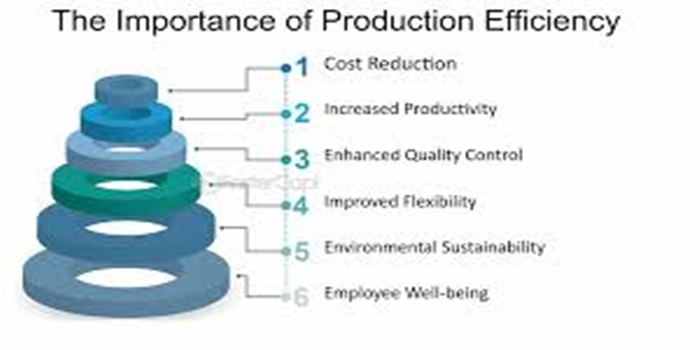
The Importance of Production Efficiency:
Cost Reduction & Profitability: Minimizing waste (materials, energy, time) lowers the cost per unit, directly increasing profit margins and allowing for more competitive pricing.
Increased Productivity: Producing more in the same or less time boosts output, fulfilling customer orders quicker and improving overall performance.
Better Resource Utilization: Ensures optimal use of labor, raw materials, and energy, reducing waste and environmental impact.
Enhanced Quality & Consistency: Efficient processes often incorporate quality control, leading to fewer defects, less rework, and more reliable products, fostering customer satisfaction.
Competitive Advantage: Lower costs, higher quality, and faster delivery give businesses a significant edge in the market, ensuring long-term resilience.
Sustainability: Efficient operations inherently reduce resource consumption and waste, contributing to a smaller environmental footprint.
Meeting Demand: High efficiency allows companies to scale production to meet unexpected or growing customer demand without sacrificing quality or increasing costs dramatically.
How to Improve Production Efficiency Without Increasing Costs:
Optimize Production Planning and Scheduling
One of the most powerful ways to improve efficiency at no additional cost is through better planning.
Aligning production schedules with actual demand
Avoiding overproduction and underproduction
Sequencing jobs to reduce changeovers and delays
Balancing workloads across machines and shifts
Well-structured planning reduces idle time, overtime, and disruptions—leading to smoother operations and higher output.
Eliminate Waste Using Lean Principles
Waste consumes resources without adding value. Lean production focuses on identifying and eliminating waste across the production process.
Common forms of waste include:
Waiting time
Excess inventory
Unnecessary movement
Overprocessing
Defects and rework
By removing non-value-added activities, production flow improves without additional investment.
Improve Workplace Organization (5S Method)
A disorganized workplace slows production and increases errors.
Implementing 5S—Sort, Set in order, Shine, Standardize, sustain—helps:
Reduce time spent searching for tools
Improve workflow and safety
Minimize errors and downtime
5S requires discipline, not capital, and delivers immediate efficiency gains.
Reduce Downtime Through Preventive Maintenance
Unplanned equipment breakdowns significantly reduce efficiency and increase hidden costs.
Cost-neutral maintenance strategies include:
Following basic preventive maintenance schedules
Training operators to perform routine checks
Identifying recurring breakdown causes
Improving communication between operators and maintenance teams
Preventive maintenance increases equipment availability and reduces production disruptions.
Standardize Work Processes
Inconsistent work methods lead to variations in quality, speed, and output.
Standardized work:
Defines the best way to perform a task
Reduces variability
Improves training and knowledge transfer
Enhances predictability in production
Once established, standardized processes improve efficiency without increasing costs.
Enhance Employee Skills and Engagement
Employees are a critical factor in production efficiency. Skilled and motivated workers perform tasks faster and with fewer errors.
Cost-effective strategies include:
Cross-training employees
Encouraging problem-solving and suggestions
Providing clear work instructions
Recognizing good performance
Engaged employees identify inefficiencies and contribute to continuous improvement.
Improve Layout and Workflow
Poor factory layout increases transportation time and worker fatigue.
Without spending money, manufacturers can:
Rearrange workstations for better flow
Minimize unnecessary movement
Place frequently used tools closer to operators
Align processes in logical sequence
Small layout changes can significantly improve productivity.
Reduce Rework and Defects
Rework consumes time, labor, and materials—without adding value.
To reduce defects:
Identify root causes of quality issues
Improve communication of quality standards
Encourage quality checks at the source
Avoid rushing production schedules
Fewer defects mean higher first-pass yield and better use of existing resources.
Improve Communication and Coordination
Production inefficiencies often stem from miscommunication between departments.
Improved coordination between:
Production and planning
Maintenance and operations
Quality and manufacturing
leads to faster problem resolution and fewer delays. Clear communication costs nothing but improves efficiency dramatically.
Use Performance Metrics Effectively
Monitoring the right metrics helps identify inefficiencies early.
Overall Equipment Effectiveness (OEE)
Cycle time
Downtime
Yield and defect rates
Using existing data more effectively enables informed decisions without additional spending.
Balance Workloads and Reduce Bottlenecks
Bottlenecks limit production flow and reduce overall efficiency.
Without adding resources, managers can:
Redistribute tasks
Adjust schedules
Improve coordination at constraint points
Reduce variability in upstream processes
Relieving bottlenecks improves throughput across the entire production line.
Encourage Continuous Improvement (Kaizen)
Continuous improvement involves making small, incremental changes over time.
Identifying inefficiencies
Testing simple solutions
Learning from results
Involving employees at all levels
This approach improves efficiency without requiring major investments.
Improve Changeover and Setup Times
Long setup times reduce available production time.
Without new equipment, organizations can:
Prepare tools and materials in advance
Standardize setup procedures
Eliminate unnecessary steps
Involve operators in improvement efforts
Reducing setup time increases productive capacity.
Leverage Existing Technology Better
Often, production systems already have unused or underutilized features.
Improving efficiency may involve:
Better use of ERP or MES data
Improving scheduling accuracy
Enhancing reporting and analysis
Maximizing current systems avoids the need for new investments.
Challenges to Improving Efficiency Without Cost:
Common obstacles include:
Resistance to change
Lack of accountability
Poor data accuracy
Short-term focus
Overcoming these challenges requires leadership commitment and cultural change—not additional budget.
Conclusion
Improving production efficiency without increasing cost is not only possible, it is often the most sustainable approach to operational improvement. By focusing on planning, waste elimination, standardization, employee engagement, and continuous improvement, organizations can unlock significant efficiency gains using existing resources. Rather than spending more, successful manufacturers work smarter, creating systems that maximize value, reduce waste, and improve performance.