


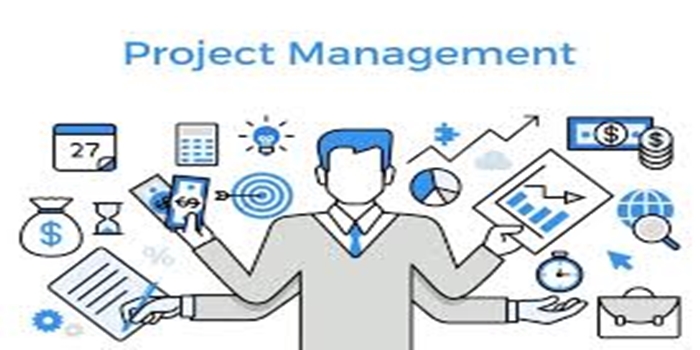
In this article, we discussed project management, the examples, the types, and the future of project management in a digital world.
Definition
Project management is the discipline of planning, executing, and overseeing projects to achieve specific goals within defined restrictions (scope, time, budget) by applying skills, knowledge, tools, and techniques, typically following phases like initiation, planning, execution, monitoring, and closure, using methodologies like Agile or Waterfall to guide teams and deliver results. It’s crucial for balancing resources and ensuring project success across various industries.
Examples of Project Management
IT and Software Development: Installing new company-wide software, updating networks, or developing a mobile app.
Product Launch: A company designing, manufacturing, and marketing a new household appliance.
Event Management: Organizing a charity fundraiser, including setting budget, scheduling volunteers, and managing venue logistics.
Construction and Renovation: Managing a home renovation, from securing permits to coordinating contractors.
Business Process Improvement: Re-engineering an e-commerce order fulfillment process.
Nonprofit Initiatives: Managing a fundraising campaign.
Large-Scale Logistics: A company project to provide new smartphones to employees, involving vendor selection, budget management, and distribution.
Disaster Recovery: Coordinating resources to rebuild infrastructure after a natural disaster.
The Types of Project Management:
Waterfall (Traditional): A linear, sequential approach where each phase must be completed before the next begins. It is ideal for projects with well-defined, unchanging requirements, such as construction.
Agile: An iterative approach focusing on flexibility, collaboration, and customer feedback. It is highly effective for software development and projects with evolving requirements.
Scrum: A subset of Agile, Scrum breaks work into short, fixed-period iterations called “sprints” to deliver value quickly. It emphasizes team accountability and continuous improvement.
Kanban: A visual workflow management system that uses boards to manage tasks, improve efficiency, and limit work-in-progress. It is ideal for continuous delivery and reducing bottlenecks.
Lean: Focuses on maximizing value while minimizing waste, making it highly efficient.
Critical Path Method (CPM): A technique for scheduling a set of project activities by identifying the longest stretch of dependent activities and measuring them from start to finish.
Hybrid: A combination of two or more methodologies (e.g., mixing Waterfall for planning with Scrum for execution) to fit specific project needs.
Extreme Programming: A specialized agile framework focused on high-quality software development, short cycles, and frequent releases.
Challenges of Project Management in the Digital World:
Communication & Collaboration Hurdles: Remote work environments often lead to fragmented communication and reduced rapport. Misunderstandings occur due to lack of face-to-face interaction, and collaboration requires more deliberate, structured efforts.
Rapidly Changing Technology & Complexity: Digital projects move at high speed, making it hard to keep up with new tools and causing existing technology to become quickly obsolete. This creates high levels of uncertainty and requires constant learning.
Remote Team Management & Morale: Fostering a strong team dynamic and maintaining motivation is difficult when members work in isolation. Tracking progress and ensuring accountability without physical presence is a major hurdle.
Data Security & Privacy: Increased reliance on digital platforms raises significant risks regarding data breaches and cybersecurity.
Cultural & Time Zone Differences: Diverse, distributed teams bring challenges in scheduling, communication styles, and cultural nuances.
Integration with Legacy Systems: Integrating modern digital solutions with older, existing systems can be complex, costly, and time-consuming.
Scope Creep & Changing Requirements: Rapidly evolving digital landscapes often lead to shifting requirements, making it difficult to keep projects within the original scope and budget.
The Future of Project Management in the Digital World:
AI and Automation: Artificial intelligence (AI), machine learning (ML), and big data analytics are automating administrative tasks, offering predictive insights, and enhancing decision-making. Tools like Natural Language Processing (NLP) are used to summarize meeting notes and analyze team sentiment.
Shift to Hybrid and Remote Work: Project teams are increasingly distributed, requiring new, flexible, and digital-first collaboration approaches.
Value-Driven Management: The focus is moving from just delivering products to delivering strategic, long-term business value.
The Accidental Project Manager: As project management skills become necessary across various roles, the field is seeing a rise in professionals who use project management tools without having a formal project manager.
Conclusion
The future of project management in a digital world is dynamic, digital-centric, and human-plus-machine driven. Technology enhances the speed, scale, and precision of project execution, but it also elevates human judgment, empathy, and strategic insight as critical differentiators.
READ: Healthcare Project Management: Compliance and Risk