


Introduction
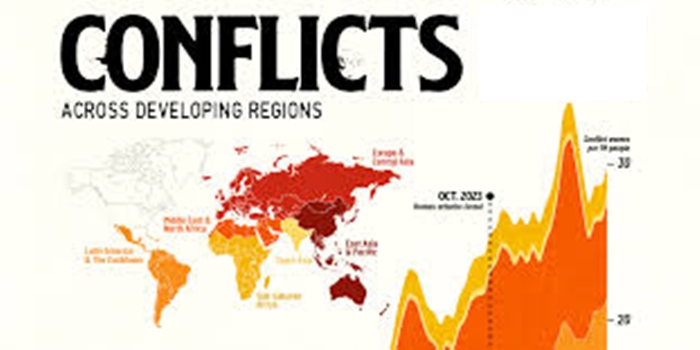
The global impact of ongoing conflicts, showing how multiple simultaneous wars and tensions affect economies, societies, geopolitics, human wellbeing, health, food systems, the environment, and the international order.
Widespread Global Conflict and Geopolitical Instability
The world is experiencing multiple active conflicts simultaneously — from Europe to the Middle East, Africa, and beyond. These include the Russo-Ukrainian war, the Yemeni civil war, Sudan’s civil conflict, and more.
Global geopolitical tensions between major powers and economic blocs have also risen, with economic confrontation now seen as a leading global risk for
The Guardian
Analysts characterize this era as “global fragmentation with peace and cooperation declining and conflict involvement at its highest since World War
World Economic Forum
Impact: A more fragmented world increases the likelihood of cross-border tensions, proxy wars, and rivalries over resources and influence, making conflict resolution more complex.
Humanitarian Crises and Displacement
Mass Displacement and Refugees
Conflicts displace millions of people from their homes. For example:
Sudan’s civil war has uprooted over 12 million people, with millions internally displaced and over 3.5 million fleeing abroad.
Many other conflicts (e.g., in Yemen, Syria, Afghanistan) continue to force families to flee violence, creating one of the largest displacement crises in modern history.
Impact:
Refugee flows put pressure on neighboring countries’ resources, infrastructure, and services.
Displacement often becomes protracted, leading to dependency on humanitarian aid and long-term instability.
Economic Consequences
Global Economic Risks
Conflicts drive economic uncertainty globally, hurting trade, investment, and growth.
The Guardian
Economic confrontation (e.g., sanctions, trade barriers) is increasingly used as a tool of geopolitical competition.
The Guardian
Direct Costs of Violence
Major research shows conflicts cost trillions of dollars annually, equivalent to a significant share of global GDP due to destruction of infrastructure, lost production, and disrupted markets. �
Vision of Humanity
Impact on Developing Economies:
Wars can stunt economic growth, reduce employment, and raise public debt.
Diverted government spending toward defense reduces investments in health, education, and infrastructure.
Food Security and Agricultural Disruption
In conflict-affected regions, farming declines dramatically, leading to food shortages and increased reliance on aid.
The Russia–Ukraine conflict, one of the world’s largest grain producers, has disrupted global supply chains, driving food price inflation and insecurity, especially in import-dependent regions.
Public Health and Healthcare System Collapse
Conflicts devastate health infrastructure, hospitals are damaged or destroyed, and medical personnel are often targeted.
Outbreaks of diseases such as cholera and tuberculosis increase in crowded displacement camps, and vaccine delivery is disrupted, heightening global public health risks. �
Impact:
Weakened health systems struggle with everyday health needs and emergency responses, increasing mortality and suffering.
Environmental and Ecological Damage
Warfare damages ecosystems through pollution, soil contamination, destruction of farmland, and disruption of ecosystems.
Major battles have resulted in contaminated waterways and large volumes of debris that are difficult to manage.
Impact:
Long-term harm to biodiversity, water quality, and agricultural productivity.
Environmental damage reduces resilience to climate change and can worsen future resource conflicts.
Social and Psychological Effects
Though harder to quantify globally, conflicts have deep social costs:
Trauma, loss of education opportunities, and breakdown of community structures affect generations.
Women and children often suffer disproportionately, facing higher rates of violence, exploitation, and interrupted schooling.
Geopolitical Realignment and Strategic Shifts
Ongoing tensions influence international alliances and power structures:
Countries reconfigure trade and defense partnerships in response to shifting risks.
Military cooperation and arms buildups have increased as states seek strategic guarantees.
This can both heighten conflict risk and trigger new forms of geopolitical competition.
Conclusion
The global impact of ongoing conflicts extends far beyond the battlefield. Humanitarian crises, economic disruption, political instability, environmental damage, and social polarization are felt across the world, highlighting the deep interconnectedness of modern societies. No conflict today is truly local; each has the potential to reshape global systems and affect lives thousands of miles away.
READ: Economic Nationalism in a Globalized World