


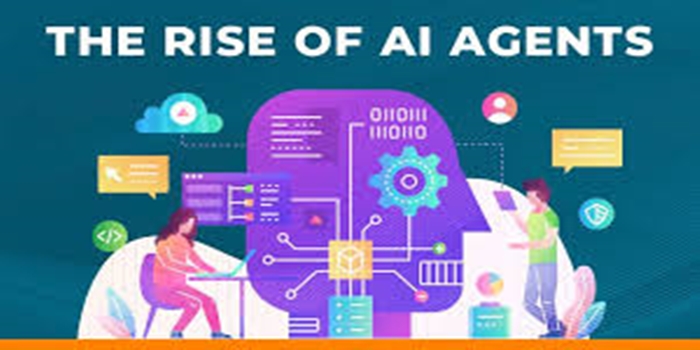
in this article, we discussed AI agents, why ai agents are rising now, how it differs from traditional automation, the capabilities of ai agents, the benefits, the challenges.
Definition
An AI agent is an autonomous or semi-autonomous software system powered by artificial intelligence that can perceive information, make decisions, and take actions to achieve a goal, Traditional AI systems typically respond to direct prompts.
Understanding objectives
Breaking tasks into steps
Using tools or external systems
Remembering context
Adapting based on results
Taking initiative within defined boundaries
Think of the difference this way:
A chatbot answers a question.
An AI agent solves a problem.
For example:
A traditional AI assistant might draft an email when prompted.
An AI agent could:
Read incoming customer inquiries
Prioritize urgent issues
Draft personalized responses
Pull information from a CRM
Schedule follow-ups
Escalate high-risk cases to humans
Learn from prior interactions
All of this can happen with limited supervision.
Why AI Agents Are Rising Now
Several technological developments have converged to make AI agents practical and scalable.
- Advances in Large Language Models
Modern language models can reason through complex instructions, understand context, and interact conversationally. This creates the foundation for agent-like behavior.
- Better Tool Integration
AI systems can now connect with:
Databases
APIs
CRMs
Email systems
Cloud platforms
Project management software
Analytics dashboards
This allows agents to move beyond conversation into real operational execution.
- Memory and Context Retention
New architectures enable agents to remember prior tasks, user preferences, workflows, and historical interactions.
- Falling AI Costs
AI infrastructure has become more accessible, allowing startups and enterprises alike to deploy sophisticated AI systems without enormous upfront investment.
- Demand for Operational Efficiency
Businesses face increasing pressure to:
Reduce costs
Improve productivity
Scale customer support
Accelerate innovation
AI agents offer a compelling solution.
How AI Agents Differ from Traditional Automation
Traditional automation relies on predefined rules.
Example: If customer says X, send response Y.
AI agents operate more dynamically.
Interpret ambiguity
Adapt to changing inputs
Learn from outcomes
Make probabilistic decisions
Coordinate multiple actions
This flexibility allows AI agents to handle workflows previously considered too complex for automation.
Capabilities of AI Agents
Autonomous Decision-Making
AI agents can independently determine the best course of action within defined constraints.
Multi-Step Reasoning
Agents can break large objectives into smaller tasks and complete them sequentially.
Agents can interact with:
Web browsers
Internal software
Databases
Productivity tools
Continuous Learning
Some agents improve over time using feedback loops and interaction history.
Collaboration
Multiple AI agents can work together as specialized systems:
Research agents
Analytics agents
Customer support agents
Workflow orchestration agents
This creates multi-agent systems, capable of managing sophisticated operations.
Customer Support
AI agents are revolutionizing customer service by:
Resolving common issues instantly
Personalizing responses
Reducing wait times
Escalating sensitive cases intelligently
Lower support costs
Improved customer satisfaction
Faster response times
Sales and Lead Generation
AI sales agents can:
Qualify leads
Send outreach emails
Schedule meetings
Analyze prospect behavior
Recommend sales strategies
This allows sales teams to focus on relationship-building rather than repetitive administrative work.
Marketing Operations
Marketing agents can:
Generate campaign ideas
Create content
Analyze engagement data
Optimize ad targeting
Monitor competitors
Conduct SEO research
Businesses can execute campaigns faster and at lower cost.
Human Resources
AI agents assist HR teams by:
Screening resumes
Scheduling interviews
Managing onboarding
Answering employee questions
Monitoring compliance documentation
This reduces administrative overhead while improving employee experience.
Software Development
AI coding agents can:
Write code
Debug software
Generate documentation
Run tests
Suggest optimizations
Development teams increasingly use AI agents as collaborative coding partners.
Finance and Operations
AI agents support:
Invoice processing
Fraud detection
Financial forecasting
Procurement workflows
Supply chain monitoring
This improves operational efficiency and decision-making accuracy.
The Business Benefits of AI Agents
Increased Productivity
Lower Operational Costs
Automation reduces labor-intensive processes and improves efficiency.
Faster Decision-Making
AI agents process data rapidly and provide actionable insights in real time.
Scalability
Businesses can scale operations without proportionally increasing headcount.
Enhanced Customer Experience
AI agents provide instant responses and personalized interactions.
Competitive Advantage
Organizations that successfully deploy AI agents can innovate faster than competitors.
Industries Being Transformed
Healthcare
AI agents help with:
Patient scheduling
Medical documentation
Diagnostics support
Administrative workflows
Retail and E-Commerce
Agents power:
Personalized recommendations
Inventory management
Customer support
Dynamic pricing
Financial Services
Banks and fintech companies use agents for:
Risk analysis
Compliance monitoring
Fraud detection
Customer assistance
Manufacturing
AI agents optimize:
Predictive maintenance
Supply chain logistics
Production scheduling
Quality assurance
Legal Services
Legal AI agents can:
Review contracts
Conduct research
Draft legal documents
Analyze case law
Challenges and Risks Businesses Must Understand
Despite the opportunities, AI agents introduce significant risks.
Security Concerns
AI agents often access sensitive systems and data. Poor controls can create vulnerabilities.
Businesses must implement:
Access restrictions
Audit trails
Encryption
Human oversight
Hallucinations and Errors
AI systems can generate inaccurate information or flawed decisions.
Critical workflows require:
Verification mechanisms
Human review
Confidence scoring
Testing frameworks
Compliance and Regulation
Industries with strict regulations must ensure AI systems comply with:
Privacy laws
Industry standards
Data governance rules
Ethical AI guidelines
Bias and Ethical Issues.
Conclusion
The rise of AI agents is reshaping how businesses operate by improving efficiency, automation, and customer experience. While the technology offers major opportunities for growth and innovation, companies must also address challenges like data privacy and workforce adaptation. Businesses that embrace AI strategically will be better positioned to succeed in the future digital economy.