


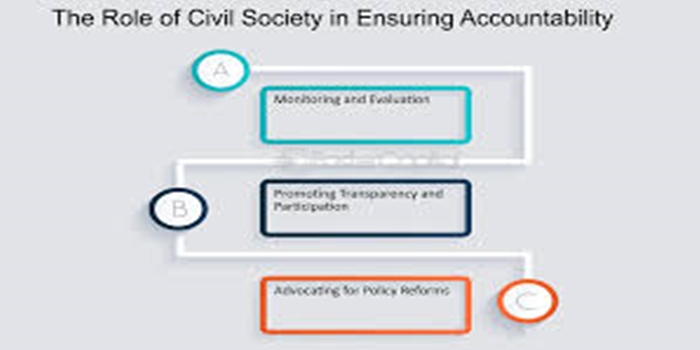
In this article, we explained civil society, the concept of accountability, devices through which civil society holds leaders accountable, contributions of civil society to democratic governance, the challenges facing civil society, the relationship between civil society and Government.
Definition
Civil society is the third sector of society, distinct from government and business, comprising non-governmental organizations, community groups, unions, and faith-based organizations. Operating independently of the state, these voluntary associations advocate for public interests, promote social justice, and influence policy. It acts as a watchdog to hold governments accountable, ensuring democratic principles and human rights are upheld.
Accountability is the obligation of an individual or organization to account for their activities, accept responsibility for them, and disclose the results in a transparent manner. It involves being answerable for actions, decisions, and policies, and often entails facing consequences or rewards based on performance. It is crucial for maintaining trust and ensuring, good governance.
Devices Through Which Civil Society Holds Leaders Accountable:
Transparency and Information Access Tools
Freedom of Information (FOI) Acts: Using legislation to force governments to release data on public spending and decision-making.
Open Data Initiatives and Portals: Utilizing government-published data on websites to track, analyze, and visualize government performance.
Public Budget Tracking: Analyzing budgets (e.g., alternative budget analysis) to ensure funds align with public commitments, often using tools to trace money from allocation to implementation.
Social Auditing and Monitoring Mechanisms
Citizen Report Cards: Surveys that allow citizens to rate public services, creating, in effect, feedback on government performance.
Social Audits and Public Hearings: Directly verifying project implementation on the ground (e.g., inspecting schools or roads) and holding public meetings where officials must answer to citizens.
Participatory Budgeting: Allowing citizens to directly participate in, or monitor, budgetary decisions and allocations.
Follow-the-Money Initiatives: Tracking specific public expenditures to identify corruption or mismanagement.
Advocacy and Legal Action
Public Interest Litigation (PIL): Filing lawsuits in courts to challenge unconstitutional policies, protect human rights, or address corruption.
Policy Lobbying: Engaging directly with legislators to influence the development and amendment of laws.
Protests and Rallies: Organizing public demonstrations to raise awareness and pressure officials into action.
Media Campaigns and Advocacy: Using traditional and social media to expose wrongdoing and shape public opinion.
Institutionalized Participation
Citizen Advisory Boards and Oversight Committees: Formal bodies where CSOs are included in reviewing government performance.
Independent Evaluations: Conducting, in effect, valuations of government programs to provide, in effect, non-partisan reports.
Capacity Building: Training, in consequence, government officials on accountability and, in effect, training citizens on their rights.
Contributions of Civil Society to Democratic Governance include:
Watchdog and Accountability Function: Civil society monitors government actions, exposes corruption, and scrutinizes human rights abuses, preventing the concentration of power.
Citizen Empowerment and Participation: Organizations educate citizens on their rights, encourage voter turnout, and mobilize public opinion to influence policy.
Policy Advocacy and Reform: Through research, lobbying, and campaigns, civil society influences legislation to reflect the needs of the people, particularly marginalized groups.
Service Delivery and Bridging Gaps: CSOs often provide essential services (health, education) in areas where public institutions are weak or absent, enhancing state responsiveness.
Fostering Inclusive Dialogue: By creating spaces for public debate and representing diverse voices, they ensure democratic processes are participatory rather than limited.
Challenges Facing Civil Society include:
Shrinking Civic Space and Regulatory Pressure: Governments are increasingly imposing restrictive laws, censorship, and surveillance that limit the ability of CSOs to operate, especially in defending human rights.
Financial Sustainability and Resources: Many organizations struggle with limited, short-term funding and intense competition for resources, hindering long-term planning.
Hostility and Safety Risks: Activists face intimidation, harassment, and delegitimization through negative discourse.
Internal Governance Weaknesses: Lack of transparency, weak internal structures, and, in some cases, poor accountability can reduce public trust and organizational effectiveness.
Impact of Global Crises: Issues like the COVID-19 pandemic, climate change, and economic disparities have compounded operational difficulties, restricting both action and funding.
Digital Divide: Limited access to technology and low digital skills prevent some organizations from effectively engaging in digital activism.
The Relationship Between Civil Society and Government
The relationship between civil society and government can be:
Adversarial, when CSOs criticize and challenge policies
Collaborative, when they partner in development initiatives
Consultative, when governments seek input on policies
A healthy democracy requires space for both constructive criticism and cooperation.
- Strengthening Civil Society’s Role
To enhance accountability:
Governments should protect freedom of association and expression.
Laws restricting civil society should be reviewed.
CSOs should maintain transparency and internal accountability.
Citizens should actively participate in civic initiatives.
Partnerships between civil society and independent institutions should be strengthened.
Conclusion
Civil society plays an indispensable role in holding leaders accountable and safeguarding democratic governance. Through advocacy, monitoring, litigation, media engagement, and peaceful activism, civil society ensures that public officials remain answerable to the people.
READ: Understanding How Social Security Works