

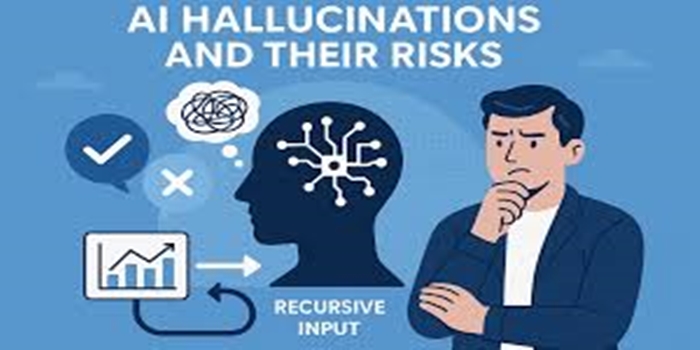
In this article, we discussed AI hallucinations, the causes, the risks, furthermore we also talked about the solutions.
Definition
AI hallucination is when an AI generates false, ridiculous, or misleading information presented as factual, often stemming from patterns in its vast training data, vague prompts, or insufficient/biased data, creating convincing but inaccurate content, like fake legal cases or historical errors, which can be problematic in critical applications like medicine or law. It’s a metaphor for the AI confidently making things up because it predicts plausible-sounding text, rather than truly knowing, leading to inaccuracies that require careful human verification.
Hallucinations can include:
Invented facts, statistics, or references
Incorrect explanations delivered confidently
Fabricated citations, legal cases, or academic sources
Inconsistent or contradictory responses
False assumptions about real-world events or entities.
The Causes of AI Hallucinations:
Probabilistic Language Modeling
LLMs predict the most likely next word based on patterns in training data. They do not “know” facts—They estimate linguistic likelihood.
Accuracy is not guaranteed unless explicitly constrained
Fluency can mask incorrect content
Confidence is not correlated with truth.
Training Data Limitations:
AI models are trained on vast but imperfect datasets.
Common issues include:
Outdated information
Biases or errors in source material
Gaps in domain-specific knowledge
Overrepresentation of certain viewpoints.
Prompt Ambiguity or Poor Input Design:
Unclear, vague, or overly broad prompts increase hallucination risk.
Asking for latest data without providing a time frame
Requesting citations when none are available
Asking the model to speculate beyond its knowledge.
Overgeneralization and Pattern Completion
AI systems are optimized to continue patterns, even when continuation is inappropriate.
They may infer details not explicitly stated
They attempt to complete incomplete information
They extrapolate beyond safe boundaries.
Lack of Grounding and Verification:
Most generative models do not automatically verify outputs against external sources.
No inherent fact-checking mechanism
No real-time access to authoritative databases (unless integrated).
Reinforcement of Overconfidence:
Models are often trained to be helpful and responsive, not to say I don’t know.
Penalized for refusing to answer
Rewarded for completeness and fluency.
Risks of AI Hallucinations:
Business and Financial Risks
Incorrect financial forecasts or assumptions
Faulty market analysis
Misleading strategic recommendations
Poor decisions, revenue loss, and wasted investments.
Legal and Compliance Risks:
Fabricated legal cases or regulatory interpretations
Incorrect contract summaries
Misrepresentation of compliance requirements
Legal liability, regulatory fines, and reputational damage.
Reputational and Trust Risks:
Publishing inaccurate content
Providing incorrect customer support responses
Loss of credibility with clients and stakeholders.
Safety and Ethical Risks
Medical or health misinformation
Incorrect engineering or safety instructions
Biased or discriminatory outputs.
Solutions: How to Reduce AI Hallucinations:
Optimize Training Data and Knowledge Bases:
The quality of data an AI model is trained on is fundamental to the accuracy of its outputs.
Use high-quality, relevant data: Focus on data that is diverse, balanced, well-structured, and specific to your domain.
Clean and vet data: Regularly remove duplicates, outdated information, and inconsistencies from the dataset.
Fine-tune on domain-specific data: For specialized applications (e.g., legal or medical), training on a curated, expert knowledge base helps prevent the model from generating generalized, incorrect information.
Implement Retrieval-Augmented Generation:
RAG is one of the most effective methods for reducing hallucinations.
Access real-time, verified data: Instead of relying solely on the model’s internal, pre-trained knowledge, RAG allows the AI to fetch information from external, trusted databases or documents in real-time to ground its responses in current facts.
Require citations: Configure the AI to cite the sources it used from the knowledge base, which makes it easier to fact-check the output.
Refine Prompt Engineering:
How you instruct the AI significantly impacts its output.
Be specific and clear: Provide detailed instructions and context to guide the AI, minimizing room for it to guess or improvise.
Set constraints: Instruct the AI on what to avoid, or limit the potential output formats (e.g., “Answer with a bulleted list; only use the provided context”).
Use Chain-of-Thought prompting: Ask the model to break down complex problems into logical, step-by-step reasoning processes, which makes its work more transparent and easier to validate.
Integrate Human Oversight and Feedback Loops:
Automated systems are not foolproof, so human involvement is a critical safeguard.
Fact-check outputs: Always verify AI-generated content, especially for high-stakes information like statistics, dates, quotes, or product claims.
Establish a feedback mechanism: Encourage users or a dedicated team to flag incorrect responses. This feedback loop can be used to continuously refine the model’s prompts or update the RAG knowledge bases.
Adjust Model Settings and Use Guardrails:
You can control some technical parameters to favor accuracy over creativity.
Control the temperature: Set the model’s “temperature” to a low value (closer to zero) to get more deterministic and conservative responses. Higher temperatures encourage creativity but increase the risk of hallucination.
Implement automated guardrails: Use tools that apply content filters, perform data validation checks, and enforce policies that keep the AI’s responses within defined boundaries and away from potentially inaccurate topics.
The Future of Hallucination Reduction:
Emerging approaches include:
Hybrid symbolic + neural systems
Fact-checking models working alongside LLMs
Multi-agent verification systems
Regulation-driven AI safety standards.
While hallucinations may never be fully eliminated, they can be reduced to acceptable risk levels with proper design and governance.
Conclusion
AI hallucinations are a fundamental and inherent challenge of generative AI, not a temporary defect. This issue stems from the way these systems’ function: they generate language, learn from data, and prioritize fluency in their output over strict factual certainty.
READ: How AI Is Transforming Business Across Industries