

In this article, we explained experience economy, the characteristics, the elements, the role of events in the experience economy.
Definition
The Experience Economy is an economic model where businesses sell memorable, personal experiences to customers, moving beyond just goods or services, creating value by engaging people emotionally, physically, intellectually, or spiritually, making experiences a distinct economic offering. It’s characterized by customization, engagement, and creating lasting impressions, with consumers increasingly preferring experiences over just owning things, seen in trends like travel, concerts, and themed entertainment.
The Experience Economy Characteristics:
Personal & Subjective: Experiences are inherently personal, existing in the mind of the individual, meaning no two guests have the exact same experience.
Memorable & Meaningful: The goal is to create lasting memories and emotional impact, fostering deeper customer loyalty than traditional products or services.
Staged Events: Companies intentionally design services as stages and goods as props to engage customers in a unique event.
Beyond Transactional: It moves beyond selling just a product (commodity) or service; it sells the transformation or feeling it provides.
The Elements of Experience Economy:
Entertainment: Passive absorption; the customer is a spectator (e.g., a movie, concert).
Esthetics: Passive immersion; the customer is absorbed by the environment but doesn’t change it (e.g., visiting a museum, beautiful garden).
Education: Active absorption; the customer participates and learns (e.g., a workshop, cooking class).
Escapism: Active immersion; the customer is fully involved and physically or mentally transported (e.g., a theme park ride, a role-playing game).
Staging Experiences: Intentionally designing events where goods are props and services are the stage for customer engagement.
Personal Connection: Experiences are inherently personal, existing in the mind and creating unique memories for each individual.
Customer Engagement: Involving customers on emotional, physical, intellectual, or spiritual levels.
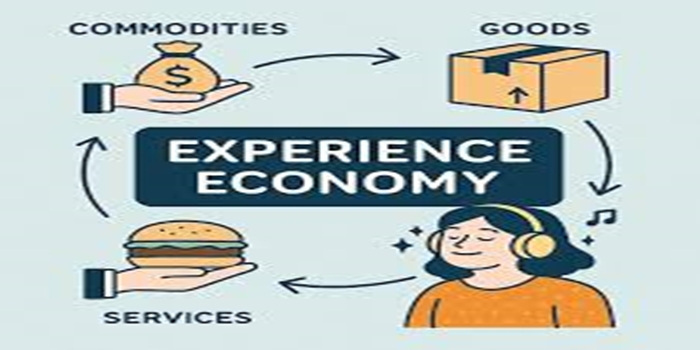
Progression of Value: Moving from commodities (fungible) to goods (tangible) to services (intangible) and finally to memorable experiences, which command higher value.
Time & Attention: Businesses compete for customers’ finite time and attention, making them valuable resources.
Authenticity: Ensuring the experience feels genuine.
Customization: Tailoring experiences to individual preferences.
Sensory Immersion: Using sensory stimuli to fully immerse guests.
Emotional Connection: Creating feelings of benevolence, joy, or connection.
The Role of Events in the Experience Economy:
Events as Platforms for Immersive Experiences
Multi-Sensory Engagement
Events stimulate multiple senses simultaneously—sight, sound, taste, touch, and even smell. Festivals with culinary experiences, tech expos with interactive displays, and concerts with visual and auditory spectacles all exemplify how events create memorable, multi-sensory experiences that stick in participants’ minds long after the event ends.
Storytelling in Action
Successful events craft narratives that guide attendees through a journey. From the moment participants register to the closing ceremony, the event tells a story—about the brand, community, or theme. This narrative creates emotional resonance, a key driver of perceived value in the experience economy.
Active Participation
Events are not passive encounters. Workshops, hackathons, trade shows, and interactive brand activations encourage active participation, giving attendees a sense of ownership and co-creation. This participatory element turns attendees into advocates and promoters, amplifying the experience beyond the physical event.
Events as Drivers of Brand Differentiation
In a crowded market, products alone rarely differentiate companies. Experiences created through events can:
Establish brand personality and identity.
Build emotional connections that influence loyalty.
Generate word-of-mouth and social media engagement.
For example, companies like Apple and Tesla use product launches as experiential showcases that go beyond information sharing—they create anticipation, excitement, and an immersive narrative that reinforces their brand image.
Social and Cultural Value of Events
Building Communities
Events bring people together around shared interests or goals. Conferences, industry expos, and local festivals foster networks and communities where ideas are exchanged and collaborations are formed. These networks become self-reinforcing, creating long-term value for both organizers and participants.
Cultural Experiences
Cultural festivals, music events, and art exhibitions exemplify how events create social experiences that enrich society.
Events and Economic Impact
Driving Revenue Through Experiences
Events generate revenue directly (ticket sales, sponsorships, merchandising) and indirectly (boosting brand loyalty, repeat business, and word-of-mouth marketing). In the experience economy, participants often value the experience more than the product or service being sold, enabling premium pricing models.
Encouraging Experiential Consumption
Events encourage consumers to spend on associated experiences—transport, lodging, dining, and merchandising. This demonstrates how experiential value creates economic activity, reinforcing the importance of events beyond mere attendance.
Technology’s Role in Enhancing Event Experiences
Virtual and Hybrid Experiences
Technology enables hybrid events that combine physical and virtual participation, expanding reach and inclusivity. Interactive apps, live streaming, and AR/VR integration create immersive experiences that are shareable and scalable.
Data-Driven Personalization
Event organizers now use data analytics to personalize experiences for attendees—customized schedules, personalized content, and targeted networking. Personalization increases engagement and emotional impact, core principles of the experience economy.
Measuring the Impact of Events in the Experience Economy
In the experience economy, traditional metrics like attendance or revenue are not enough. Success is increasingly measured by:
Emotional engagement: How did participants feel?
Memorability: Will attendees recall the experience months later?
Social amplification: Are participants sharing the experience online?
Community and network effects: Did the event foster new connections or collaborations?
These metrics align with the experience economy’s focus on lasting impressions and value beyond the tangible.
Designing Events for Maximum Experiential Value
To thrive in the experience economy, event organizers should:
Focus on storytelling: Every aspect of the event should contribute to a cohesive narrative.
Prioritize engagement over presentation: Hands-on activities, interactivity, and networking matter more than lectures or passive sessions.
Leverage technology wisely: Use AR/VR, apps, and social media to enhance immersion and extend reach.
Measure experiences, not just attendance: Use surveys, sentiment analysis, and social media engagement to evaluate emotional impact.
Create memorable, shareable moments: Experiences that are visually striking or emotionally resonant encourage organic sharing and advocacy.
Conclusion
Events are central to the experience economy because they transform interactions into immersive, memorable, and shareable experiences. They create emotional engagement, foster communities, amplify brand value, and generate economic and cultural impact. In the modern economy, companies and organizers who understand this shift are no longer selling products or services, they are curating experiences. Done well, events become platforms for storytelling, connection, and long-term value creation, making them indispensable in the experience-driven marketplace.