

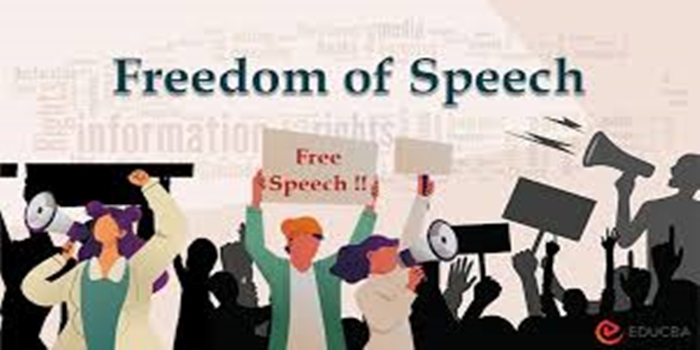
In this article, we discussed freedom of speech, the expansion of speech through digital technology, the role of technology companies, global inequality and cultural differences, balancing freedom and responsibility.
Definition
Freedom of speech is the fundamental right to express ideas and opinions without government censorship or fear of punishment, crucial for democracy, but it’s not absolute; it generally protects even offensive speech but can be limited for things like inciting violence, hate speech, defamation, or threats, with restrictions needing legal justification and serving a public interest, as recognized by international rights.
The Expansion of Speech Through Digital Technology:
Digital platforms have revolutionized who can speak and who can be heard. In earlier eras, access to mass communication was limited to those who controlled newspapers, radio, or television. Today, anyone with an internet connection can publish opinions, share videos, mobilize supporters, or criticize powerful institutions. Blogs, social media, podcasts, and messaging apps have democratized expression, allowing marginalized voices to bypass traditional gatekeepers.
The Roles of Technology Companies:
Innovation & Disruption: Develop cutting-edge tech (AI, cloud, mobile) that transforms industries and creates new business models.
Connectivity & Collaboration: Build platforms (social media, messaging) that connect people and businesses globally, breaking down geographical barriers.
Economic Growth: Stimulate job creation and help businesses, especially small ones, scale and compete globally.
Efficiency & Automation: Streamline operations, automate tasks, and provide data-driven insights for better decision-making.
Customer Experience: Enhance engagement through personalized services (Netflix recommendations) and accessible platforms (e-commerce, delivery apps).
Small Businesses: Gain tools (digital marketing, payment apps) to compete with larger firms and survive challenges like the pandemic.
Data-Driven Decisions: Enable real-time analytics for strategy, pricing, and operations.
Market Expansion: Provide e-commerce and digital marketing to reach global audiences.
Societal Impact & Challenges:
Improved Quality of Life: Offer new entertainment, communication, and convenience.
Ethical Concerns: Raise issues around data privacy, algorithmic bias, and the influence of large tech companies.
Global Inequality and Cultural Differences:
Cultural Drivers of Inequality: Cultural processes such as identification (labeling or stereotyping groups like refugees or LGBT individuals) and rationalization (standardized testing or bureaucratic procedures) can create and reinforce social and economic inequality. For example, in many developing communities, cultural practices may prioritize male education over female, restricting women’s access to resources.
Dimensions of Inequality: Global inequality is evident in disparities in health (e.g., access to care), education, and income, with significant differences between rural and urban areas within countries. Cultural status, such as language and religious practices, can also be a source of inequality, often leading to group mobilization and conflict.
Intersectionality: Cultural differences often intersect with other forms of inequality, such as race, class, gender, and sexual orientation, to exacerbate disadvantages for marginalized groups.
Impact of Globalization: While globalization has increased economic growth and reduced some inequalities between countries, it has also widened income inequality within many countries and, in some cases, caused local cultural traditions to be replaced by more homogenized, Western-influenced ones.
Overcoming Cultural Inequality: Addressing these issues requires cultural competence—the ability to understand and respect different cultural backgrounds—and the dismantling of systemic barriers to equality, such as discriminatory policies, to foster inclusive development.
Balancing Freedom and Responsibility:
Freedom of speech has never been absolute. In the digital age, the challenge lies in balancing:
Individual liberty
Protection from harm
Democratic integrity
Technological realities
Effective approaches may include:
Transparent and accountable content moderation
Clear, narrowly defined laws consistent with human rights standards
Digital literacy education to help users critically evaluate information
International cooperation on cross-border digital governance.
Conclusion
Freedom of speech in the digital age is both empowered and endangered by technology. Digital platforms have revolutionized expression, enabling unprecedented participation in public discourse. Yet they have also introduced new forms of control, harm, and inequality. The central challenge of our time is to preserve the core value of free expression while adapting legal, social, and ethical frameworks to a rapidly evolving digital environment.