

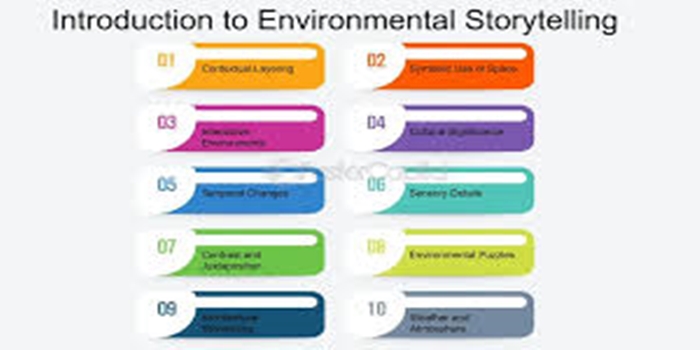
In this article, we discussed the environmental storytelling, the characteristics, the types, the techniques, we also talked about how environmental storytelling replaces exposition.
Definition
Environmental storytelling is the technique of using the environment itself, through its layout, objects, and details, to tell a story and convey information rather than relying solely on dialogue or cutscenes. It relies on player observation and inference to build the world and its history, often through subtle clues like an abandoned house with a meal on the table or skeletons posed to suggest a story. This approach is common in video games and theme parks to enhance player immersion and emotional connection to the world.
The Characteristics for Environmental Storytelling:
Subtlety and Implication Rather than explicitly stating facts, the story is implied through visual cues, allowing the audience to piece together events and history on their own. This provides a sense of discovery and fulfillment.
Cohesion and Consistency All elements within the environment must make sense within the established theme and world. Inconsistencies can break immersion.
Player/Audience Interpretation The effectiveness depends on the audience’s ability to interpret the context and semiotic domain (shared understanding of symbols). Their prior knowledge is used to infer the narrative.
Visual Cues and Object Placement Individual objects (a blood-stained robe, a broken chair, skeletons posed in a specific way) serve as artifacts that, when combined, tell a larger story about past events or the occupants’ lives.
Emotional Resonance and Atmosphere Lighting, sound design, and color palettes are used to evoke specific emotional tones or a sense of atmosphere (e.g., tension, decay, relief), which in turn enhances the narrative.
Non-Linear Discovery Environmental storytelling encourages exploration, allowing the audience to discover narrative fragments in a non-linear fashion, building their own understanding of the world at their own pace.
Integration with Gameplay/Interaction In interactive media, the environment is not just a backdrop; it is integral to the experience. The design guides the player’s movement and choices, making the setting an active participant in the storytelling process.
The Types of Environmental Storytelling:
Embedded narratives: The story is embedded within the environment and must be pieced together by the player.
Examples: The arrangement of objects in a room, such as a skeleton in a bathtub, can suggest a specific event. Players might find documents, audio logs, or other clues that provide lore and backstory.
Enacted narratives: The environment is used to stage story events as they happen, which the player either performs or witnesses.
Examples: A cutscene that plays in a specific location, or a scene where the player is forced to interact with the environment to progress the story.
Emergent narratives: The environment is designed to give players the tools and resources to create their own stories through their actions.
Examples: Games that rely on player-created narratives, such as a player building a shelter in a survival game, or a puzzle game that requires players to use the environment to solve a problem.
Spatial and atmospheric cues: Using elements like lighting, sound, and set dressing to convey mood and information. For instance, a very dark, silent, and decaying environment might suggest a place is dangerous or haunted.
Vignettes: A technique where a small, self-contained scene or “storytelling vignette” is created from environmental details to imply a past event.
Examples: Finding a broken chair and wine glasses to suggest a struggle, or a child’s drawing taped to a wall to imply the past presence of a child.
Contextual puzzles: Using environmental storytelling to explain why a puzzle exists or why a specific puzzle element is placed where it is.
Scale: Ranging from large-scale environmental storytelling, such as a pervasive infection that has changed the world, to localized storytelling, such as a single skeleton in a bathtub.
Techniques in Environmental Storytelling:
Visual details: Specific details like graffiti, blood on the floor, or a broken chair can hint at past events or character backstories.
Placement of objects: The strategic placement of props, like a toy left behind, can create narrative meaning.
Cultural markers: Architecture, symbols, or artifacts can add depth and lore to the world.
Lighting and sound: Using non-verbal cues like lighting and sound design can convey emotions and set a specific atmosphere.
Thematic consistency: Creating consistent themes and motifs through the environment helps reinforce the narrative and provide a sense of cohesion.
Layout and geometry: The shape, scale, and arrangement of a space can be used to reflect a character’s emotional state or the narrative’s progression. For example, using narrow corridors to create a sense of pressure.
Encourage exploration: Environmental storytelling works best when players are free to explore and piece together the narrative at their own pace, fostering curiosity and engagement.
Player-driven discovery: The story is revealed through the player’s exploration and interpretation of the environment, rather than being delivered through explicit cutscenes or dialogue.
How Environmental Storytelling Actually Replaces Exposition:
Show, Don’t Tell” Philosophy: Instead of telling players the history of a place, the environment shows the consequences of past events through visual cues. For example, in games like The Last of Us, overgrown cities and abandoned homes filled with scattered belongings tell a story of societal collapse without lengthy narration.
Player as Archaeologist: Environmental storytelling encourages players to become “active archaeologists” who piece together fragments of lore and context. Clues such as a broken sword beside a long-dead knight, a child’s drawing on a dusty wall, or a bloodstained robe hint at past events and character fates, rewarding curiosity and observation.
Trusts Player Intelligence: This method respects the player’s ability to draw conclusions and form their own interpretations, leading to a more profound sense of discovery and personal investment in the world. The story feels “earned” rather than force-fed.
Atmosphere and Spatial Design: The layout, lighting, and ambient sounds of an environment can convey mood, context, and emotional information implicitly. Tight corridors create tension, while open spaces can evoke vulnerability. This atmospheric storytelling provides context that traditional exposition often struggles to match.
Integration with Gameplay: By making the environment the primary narrative vehicle, the storytelling becomes part of the core gameplay loop (exploration and interaction) rather than a break from it. This prevents ludo narrative dissonance and ensures a more cohesive experience.
Examples in Practice
Dark Souls series: The Dark Souls games are renowned for their minimal direct exposition. The rich, complex lore is primarily hidden in item descriptions, architectural layouts, and the placement of enemies and objects, requiring dedicated players to piece together the world’s history through careful exploration and community discussion.
Gone Home: This game is built almost entirely on embedded narrative. Players explore an empty house and uncover the story of the family who lived there through finding personal notes, audio diaries, and interacting with everyday objects, with very little traditional dialogue or cutscenes.
BioShock: The underwater city of Rapture uses Art Deco architecture and audio logs left by its inhabitants to illustrate the rise and fall of a utopian society, effectively using the setting itself as an ideological commentary and narrative tool.
The Future: AI and Dynamic Environmental Storytelling
As AI-driven worlds and virtual spaces rise, environmental storytelling will enter a new era.
- Procedural environments that react to player choices
Worlds that age, decay, or evolve based on actions.
- Personalized environmental storytelling
Worlds that adapt narratively to user psychology.
- Real-time narrative environments in VR and AR
Story becomes a fully spatial, multi-sensory experience.
- AI-generated environmental narratives
Tools that let creators build rich worlds instantly using natural language prompts.
Conclusion
Environmental storytelling is a technique where the physical space itself is designed to convey narrative information, history, and mood, effectively transforming exposition rather than replacing it. Environmental storytelling isn’t a replacement for exposition — it’s a transformation of it. Instead of explaining the narrative, creators design environments that embody the narrative.