

in this article, we discussed natural gas, the natural gas procession, the role of technology in modern Gas production, why Gas processing Is So important, the future of natural Gas production and processing.
Definition
Natural Gas is a naturally occurring mixture of hydrocarbon gases found beneath the Earth’s surface. Its main component is methane, although it can also contain smaller quantities of ethane, propane, butanes, pentanes, carbon dioxide, nitrogen, hydrogen sulfide, water vapor, and other compounds.
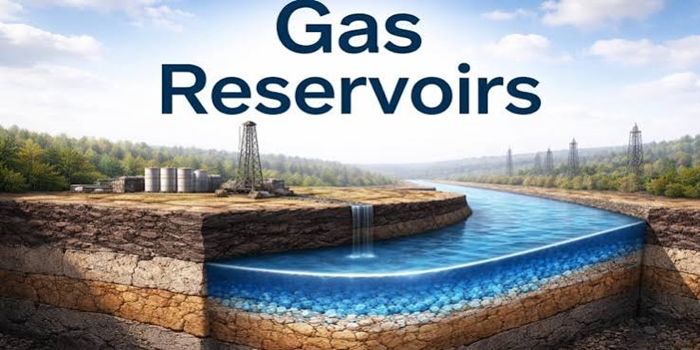
Natural gas can occur in several types of reservoirs.
It may be found in conventional gas reservoirs, where gas accumulates in porous rock formations and can flow relatively easily toward a well. It can also occur alongside crude oil in oil reservoirs. In this case, it is known as associated gas.
Gas found in reservoirs without significant quantities of crude oil is commonly called non-associated gas.
Natural gas can also be produced from unconventional resources, including shale formations and other low-permeability rocks. These resources may require techniques such as horizontal drilling and hydraulic fracturing to create pathways through which the gas can flow.
Regardless of the type of reservoir, the basic objective is the same: safely bring the gas from the subsurface to the surface and prepare it for use or transportation.
The Natural Gas Production Process
The journey of natural gas begins long before drilling starts.
- Exploration and Geological Studies
Before a company drills a well, geoscientists investigate an area to determine whether commercially recoverable hydrocarbons may be present.
Exploration can involve:
Geological mapping
Geochemical analysis
Seismic surveys
Well data
Satellite and remote-sensing information
Analysis of existing geological records
One of the most important technologies used during exploration is seismic imaging.
Seismic surveys use controlled sound energy to generate reflections from underground rock layers. Computers then process these reflections to create an image of geological structures beneath the surface.
Geologists and geophysicists analyze these structures to identify formations that could potentially contain hydrocarbons.
Exploration does not guarantee that natural gas will be discovered. A structure may contain water, hydrocarbons that are not commercially recoverable, or insufficient quantities of gas.
This makes exploration an important risk-management stage of the natural gas industry.
- Drilling a Natural Gas Well
Once exploration identifies a potentially commercial reservoir, drilling can begin.
Drilling involves creating a wellbore from the surface into the target formation.
Onshore wells are drilled using land-based drilling rigs, while offshore wells require specialized drilling units or platforms.
A modern drilling operation typically involves several important stages.
Drilling the Wellbore
A drill bit cuts through layers of rock as the well becomes deeper.
Drilling fluid, often called drilling mud, circulates through the well. It helps cool and lubricate the drill bit, carry rock cuttings to the surface, and maintain pressure control within the well.
Installing Casing
Steel casing is installed in sections as drilling progresses.
Casing provides structural support for the well and helps isolate different geological formations.
Cementing
Cement is pumped into the space between the casing and surrounding rock.
The cement helps secure the casing and provides zonal isolation, reducing the risk of unwanted fluid movement between formations.
Completing the Well
Once the target reservoir has been reached, the well is completed so that natural gas can flow from the formation into the wellbore.
Completion methods vary depending on the geology and reservoir characteristics.
- How Natural Gas Reaches the Surface
Natural gas is held underground under pressure.
When a producing well is opened, reservoir pressure can cause gas to flow through the formation and into the wellbore.
In some reservoirs, natural pressure provides much of the initial energy needed to produce the gas.
Other reservoirs require additional techniques to maintain production.
Production equipment at the surface controls the flow of gas and separates it from other fluids produced from the well.
The gas emerging from a production well is rarely ready for immediate use.
This is because “raw” natural gas can contain several unwanted substances.
- What Comes Out of a Gas Well?
Raw natural gas can contain:
Methane
Ethane
Propane
Butanes
Heavier hydrocarbons
Water
Carbon dioxide
Nitrogen
Hydrogen sulfide
Mercury and other trace contaminants
It may also contain condensate or crude oil, depending on the reservoir.
The exact composition varies considerably from one field to another.
This variation is one reason gas-processing facilities must be designed according to the characteristics of the gas they receive.
- Gathering the Gas
After production, gas from individual wells is transported through a gathering system.
A gathering system consists of pipelines and associated equipment that collect gas from multiple wells and deliver it to a central processing facility.
The system may include:
Gathering pipelines
Manifolds
Separators
Compressors
Metering equipment
Valves
Dehydration equipment’s
The objective is to consolidate production efficiently while maintaining safe pressure and flow conditions
In large fields, hundreds of wells may eventually feed into a network connected to one or more processing facilities.
- Separation of Gas, Oil, and Water
At the production facility, the initial processing step is often separation.
A production separator uses differences in density and physical properties to separate the produced fluids.
A typical stream may contain:
The separator allows these phases to separate.
The gas moves toward the gas-processing system.
Liquid hydrocarbons may be sent for stabilization and further processing.
Produced water is treated and managed according to applicable environmental and operational requirements.
Separation is essential because the different components require different processing and transportation systems.
- Gas Dehydration
Water is one of the most common contaminants in raw natural gas.
It must be removed because water can create several problems.
One major concern is hydrate formation.
Gas hydrates are solid crystalline compounds that can form when water and natural gas components combine under certain pressure and temperature conditions. They can restrict or block pipelines and equipment.
Water can also contribute to corrosion.
For these reasons, natural gas is usually dehydrated before entering long-distance pipelines.
The Role of Technology in Modern Gas Production
Technology has transformed natural gas production.
Modern facilities increasingly use automated control systems, sensors, advanced data analytics, remote monitoring, and predictive maintenance.
Digital systems can monitor:
Pressure
Temperature
Flow rates
Equipment performance
Gas composition
Pipeline conditions
Methane emissions
These technologies help operators identify abnormal conditions and respond before small problems become major operational or safety incidents.
Safety in Natural Gas Production and Processing
Safety is fundamental throughout the natural gas value chain.
Natural gas is highly flammable, while some raw gas streams can contain toxic substances such as hydrogen sulfide.
Facilities therefore incorporate multiple layers of protection.
These can include:
Gas detectors
Fire detectors
Emergency shutdown systems
Pressure-relief systems
Blowdown systems
Automatic isolation valves
Safety instrumented systems
Fire suppression equipment
Hazardous-area electrical equipment
Emergency response procedures
Personnel also require specialized training to operate and maintain gas facilities safely.
Why Gas Processing Is So Important
Gas processing is sometimes overlooked because consumers generally encounter natural gas only after it has already been treated.
But processing is essential.
Without appropriate treatment, raw natural gas may contain water, acidic gases, heavy hydrocarbons, and other substances that can damage equipment, create safety hazards, reduce gas quality, or prevent the gas from meeting pipeline and market specifications.
Gas-processing plants therefore serve as a bridge between underground reservoirs and the commercial energy market.
They transform a complex mixture of hydrocarbons and impurities into products that can be safely transported and used.
The Future of Natural Gas Production and Processing
The natural gas industry continues to evolve
Future facilities are likely to make greater use of automation, digital monitoring, advanced process control, methane detection, energy-efficient equipment, and lower-emissions technologies.
There is also growing interest in reducing the emissions associated with gas production and processing.
Potential approaches include:
Electrification of equipment
Renewable electricity
Methane leak detection
Reduced flaring
Carbon capture
Energy-efficiency improvements
Digital emissions monitoring
Low-emissions compression
Improved gas recovery
At the same time, the industry faces the challenge of balancing energy demand, affordability, reliability, safety, and environmental performance.
Conclusion
Natural gas production and processing involve several important stages, from exploration and drilling to treatment, transportation, and delivery. Modern technologies help ensure that gas is produced safely, efficiently, and to the quality standards required by consumers. As the industry evolves, greater focus on efficiency, methane reduction, and environmental management will continue to shape the future of natural gas.
READ: Understanding Natural Gas as a Growth Engine